Showing posts with label ownership. Show all posts

Saturday, 28 November 2020

Corporate control on the cheap?

A couple of years ago, I got into the guts of the Melrose Industries hostile takeover of GKN. This deal squeaked through, despite it being opposed by GKN employees.

The bit of it that particularly interested me was the role of hedge funds doing the merger arbitrage trade, which ended up influencing a major part of GKN's shares (and simultaneously shorting Melrose). I say 'influencing' as the overwhelming majority of the funds' exposure to GKN was through derivatives, rather than ownership of its shares. 

My understanding of how this corner world works is that hedge funds utilise equity derivatives primarily because they are cheap. It costs a lot of money to buy 1% of a PLC, and if a hedge fund with a few billion under management went out and bought the shares it would represent both a big expenditure and a very significant position. So using CFDs or swaps enables them to gain exposure to movement in the target's shares without having to pay to own the underlying asset. They obviously pay for the derivative itself, but that's a fraction of the cost of the underlying equity.

As I blogged previously about GKN, my understanding is that, as the counter parties to the derivatives, investment banks end up holding shares. Again, no problem in principle, and everyone is clear that it is the hedge funds which have the economic interest in the shares even if they don't own them. If the hedge funds have long derivatives they make money if the shares go up and lose it if they go down. That in turn means that if the bid fails they lose money, so holders of long derivatives obviously want the bid to succeed (or look to be set to do so - if they got in early they could take profits before the outcome is decided I suppose).

In a hostile bid the bidder essentially makes an offer over the heads of the incumbent management of the target to the company's shareholders. Those shareholders in turn have to decide by a set deadline whether or not to accept that offer. If you're a shareholder you can accept that offer or not (and the management of the target will be telling you to ignore it) and if you're not a shareholder you can't. And by extension, if you hold derivatives, not shares, you're not a shareholder. So you can't respond to the bid. 

So far so simple. But what if you're an investment bank that holds the shares as a counterparty to a derivative holder? You do hold the shares, but only because of the derivatives. How do you decide how to respond? Pure survival instinct is surely going to tip you to support the bid because you know that your valuable hedge fund client is going to lose money if the bid looks like it might fail. It is possible, even, that the derivative is written in a way that stipulates this, though I simply do not know if this is the case or not.

My issue is that this may mean that de facto those holding derivatives are able to exercise influence on the outcome of bid equivalent to that of an investor holding equity. If so this is influencing what we used to call the market for corporate control on the cheap. It doesn't feel right to me that investors whose only interest is in an instrument that mirrors the share price, and its appreciation during the limited timeframe of the process a bid, should be able to influence the ownership of major employers.

I could be off-target on some of this so would welcome any corrections etc from anyone who knows this area better than I do. I will keep private just email if you don't want to comment on here. (I'd also be interested to find out how much gaining an exposure of say 1% via derivatives actually costs vs buying the shares.) But I think I do have the outlines broadly right. If so, I think this ought to attract more attention than it does currently. 

PS. Given that a change in ownership is absolutely fundamental to a company's future this is very obviously a significant stewardship issue. Yet, as I've blogged before, a number of the funds active in the merger arbitrage market do not adhere to the Stewardship Code.

Sunday, 10 May 2020

Concentration, alignment and pre-distribution

Like most people, I'm not really clear at what stage we are in the Covid-19 outbreak. Confused briefing to the papers (and a new strap line that doesn't include "Stay Home") suggests to me that in general the government *is* easing the lockdown de facto, even if it isn't saying much publicly. But conversely almost everything I hear through work points to continued disruption for months or years ahead.

With that in mind, it's worth thinking about some of the things from this highly unusual period that might endure. Waking up to the absence of noise, and walking around seeing very little traffic, has been a revelation in London. But I suspect that travel levels will creep back up, which is rather sad. And in any case, I'm going to stick to my knitting and cover a few things I know a little about.

Concentration

Concentration - both in ownership and within sectors - is something I think could be a lasting effect of the crisis. On ownership first, I think the big asset managers, and particularly the passive managers, will emerge stronger from this crisis.

I've been following asset management for over 20 years, and throughout that time I've heard the argument made that it's during a downturn that you really want active management, rather than just tracking the index down. It's never been borne out by events, and throughout the past couple of decades all that is happened is that assets have shifted from active to passive. I think this crisis will only add to that trend.

There's an interesting piece in the FT on this topic here which points out that the concentration of assets with a handful of investment groups had surged since the start of 2020. The largest 1% of investors now account for 63% of total industry assets.

There are couple of noteworthy comments in the article below:
Mr Miller said that concentration was also accelerating at fund level, with investors channelling more money into large, low-cost, predominantly passive funds. “We’ve seen investors buck the idea that active managers can outperform in a downturn,” he said.  
and
Mr Miller warned that the concentration of assets in the hands of fewer decision makers could increase baseline market volatility in future. He added: “It could also make the heads of the largest asset managers incredibly powerful influencers of the global economy as they can exert serious pressure on their portfolio companies.”
I don't currently see anything that is likely to change this. We can see ongoing consolidation within the industry and the continuing active to passive shift. On one level this is fine. I don't have much faith in active management, and the sheer number of active funds on sale seems ridiculous.

However, the concentration of power in the hands of a small number of players is significant. Some people in my world must think this is a good thing, since the separation of ownership (let's leave this aside for now!) and control is supposed to be the flaw in the public company that corporate governance and stewardship seeks to mitigate. But it doesn't feel like a victory does it?

The fact that this concentration is being driven in large part by investors going passive raises other questions. For example, at what point does that fact that much of the money invested in the market is not making active buy/sell decisions start to distort it? I remember first hearing this argument in the late 1990s when the point seemed fanciful, but we are now at the point where more money is being managed passively than actively.

Also, if asset managers have a position in a company simply because it is in a given index why should their views on ESG issues be more desirable than those of the underlying beneficiaries? Part of the story of responsible investment in the early years was that it was going to democratise the finance sector, and let those whose money was fuelling it have a greater say. But in practice what is happening is that large passive managers are agglomerating that power for themselves. My personal view is that the fact that it's investment professionals who call the shots in part explains why RI has such a wealthy liberal feel to it. But that's for another day...

Industry concentration

The other side of the concentration question relates to market structure. There are a number of elements to this. First, it's inevitable that this crisis will kill businesses that were already weak, in turn they might be picked over by other firms which survive and might be able to pick up bargains in the current climate.

Second, there are certain sectors that seem likely to be particularly affected. I read a piece on The Nation (which I can't find now!) looking at the impact on shopping streets in the US. The argument was that smaller independents would lose out to larger chains. Certainly it seems a safe bet that Amazon emerges stronger at the end of this. But it will surely go beyond this. Airlines looked ripe for more consolidation in any case as a number had failed or looked like they were going to.

Third, competition policy seems likely to be relaxed, even if not explicitly. For example, the CMA in the UK recently issued guidance on its stance in response to Covid-19. It essentially said that its position was unchanged. However the CMA's existing position was that it would take into account the financial viability of the company potentially being acquired. If there was a risk of business failure it might allow a takeover. Well, in the current environment there must be more cases where businesses are at risk of collapse, ergo it seems likely that more acquisitions that might otherwise have failed to gain clearance are approved. I don't want to oversell this point, but it's worth bearing in mind.

Incidentally, while I was looking for a separate article I found this piece from Aviva Investors which covers a number of the points I make above in more detail, and adds a few more.

Ownership + industry concentration to stay?

The combination of ownership and industry concentration was already attracting attention in public policy land. If the present crisis does reinforce both trends the issues that this raises become sharper. But I'm not sure that governments are going to want to unpick any of this or feel compelled to do so.

I've always felt that making anti-trust / pro-competition policy a centrepiece of a political programme feels a bit too abstract, despite the legitimacy of the points this would be intended to address. How many people get out of bed to campaign for 'challenger banks' for example? And who are the allies that they can count on. Arguably a capitalism dominated by a handful of big firms in each sector is better for reinvigorated bargaining by labour if that were ever to occur.

So on balance I think we are shifting to greater concentration and I don't think too many people will be motivated to do much about it.

Executive pay: aligned with who? 

Onto more pure governance turf, I think changes to executive pay so far in the crisis deserve a look. As many people will be aware, the most common response from companies has been to cut base salaries for directors, with cuts around 20% of salary typical. The symbolism is pretty clear - many workers are furloughed on 80% of their normal salary, so the execs get paid 80% of their normal salary, or something similar. In some cases directors are also giving up or deferring bonuses, and in a smaller number of cases LTIP awards. Overall these types of changes have been generally seen as a good thing.

A question to consider here is how easy it will be to return to normal. For example, if an executive has taken a 20% pay cut during the furlough, is it ok to put the salary back to 'normal' once furloughing is over? What if the company has reduced its headcount? What happens when a bunch of companies push executive salaries back up? I can imagine some resistance to putting pay back to 'normal' levels.

Also, imagine in contrast if a company emphasised that it felt it was important for executives to continue to have considerable variable pay with a substantial equity component in order to ensure that their interests were aligned with those of shareholders. Even if they went to say that aligning directors' interests with shareholders would deliver value for all stakeholders (blah blah blah) it wouldn't feel right in the current environment.

But why not? If public companies are supposed to be run in the interests of shareholders, and this is justified on the basis that there is no conflict between different stakeholder interests and therefore those other stakeholders benefit from such a focus, why shouldn't directors continue to prioritise shareholders? Why are they aligning their pay with their employees rather than their investors?

The common sense answer is that companies understand that this is a moment at which it is important to prioritise employee safety. You could manufacture an argument that not doing this would be damaging to brands, and thus to profitability, and thus it's actually in the interests of shareholders to put employees first, for now. However I don't think anyone really believes that. But it does again raise the question of whether different interests are in conflict and, if they are, whose should come first.

Shareholder primacy paused

I've written elsewhere that I think shareholder primacy has been paused for the time being. For certain companies this is more obvious than others. For example, in a number of markets banks and insurers have been told to stop dividends, buybacks and payment of bonuses. Similarly in some countries those companies that are receiving state support are barred from such activity. In the first case, regulators seem to have adopted this stance to ensure that financial institutions are well capitalised, in the second it's more a question of ensuring that taxpayers are not subsidising investors.

Again, if there were no conflicts of interests this doesn't seem like it should be necessary. For example, banks would cancel dividends and buybacks because they knew they needed to do so to preserve capital and in doing so ensure they were delivering long-term value to shareholders.  Actually, it seems that the UK's banks were not planning to scrap dividends before they were told to, and Standard Chartered was carrying on with its buyback right up the last moment. Does this mean that the PRA was wrong to tell them to stop?

An obvious retort is that this in an extraordinary situation and such moves might be politically necessary if not necessarily economically efficient. By which I mean simply that banks paying huge dividends and bonuses during a time of high unemployment might cause other, bigger problems. But is this only the case during a crisis, or is this just the moment at which we can see more clearly where the tensions are?

There was already increasing discussion of the merits of shareholder primacy before the pandemic hit. I think a shift back to arguing - explicitly - in favour of the model looks unlikely, though we might see lots of tortured arguments along the lines that actually lower dividends and no buybacks are good for shareholders. Therefore this might be another aspect of changed governance that endures.

Stakeholder alignment and pre-distribution 

Finally, here's something I'm hoping for. I am glad to see Ed Miliband back in a frontline role, and shadow business feels like the ideal place. When we was Labour leader he toyed with the idea of pre-distribution even if there wasn't much flesh on the bones. Maybe now is the time to revisit it. Thinking again about changes to executive pay, a model of stakeholder alignment would surely put a much greater emphasis on profit-sharing and similar models whereby the entire workforce gains when the business succeeds.

It's always struck me as bizarre that there is more interest in putting 'employee engagement' targets into incentive schemes for executives than ensuring employees are engaged. Rather than paying A in a way that might incentivise them to ensure that B is engaged, why not just focus on how B is paid?

Once more, things were already moving in this kind of direction. For example, disclosure of pay ratios really wasn't driven by investor interests, and the data that is being disclosed is going to be used by a much wider set of stakeholders. So this does feel like an area where more is likely to happen. I know some people are already thinking about these kinds of issues, so let's encourage it. Let's make stakeholder alignment an objective in pay discussions from here on.

Finally, this in turn points to a different way of thinking about engagement. As I've written before I think a model which focuses on interactions between senior corporate staff and senior investment staff is flawed. This is the approach which spits out ideas like putting employee engagement KPIs in LTIPs because the conception is that is the strata that matters, and that is where the action happens, even if the bulk of the company is not involved. But again more later...

Saturday, 21 March 2020

Capitalism: down with the sickness

I'm just a humble labour & corpgov wonk, so most of the time the kinds of things that interest me are buried in the business pages. But it feels like, as with the financial crisis, questions about who controls businesses and how, and in whose interests, they should be run are going to become big political issues once more.

As I've made clear previously I have *zero* knowledge of Covid-19 beyond what anyone else can read. All I can speak with any sense about is how I see it impacting the areas that I do know about. So here are a few quick thoughts about the direction of travel.

First up, we should expect a very sharp turn away from normal expectations across the market. Dividends are already being suspended by many companies as they admit they can't accurately forecast what will happen in the months ahead. Buybacks are not going to have a good crisis, and many are being suspended. Some boards have already announced that directors are cutting their own pay, more will surely follow. At work we've been trying to get companies to embrace common sense on this.

Second, some companies will get it badly wrong, and this may do them serious damage. EasyJet is taking a lot of flak for proceeding with a £174m dividend payment even as it seeks state support (it claims it is compelled to make the payment, which is something I need to check out). Ryanair spent millions on a share buyback during March even as it cancelled hundreds of flights. One report I read yesterday said it is cutting staff pay by 50% (O'Leary is taking the same pay cut, but he doesn't really need the money does he?). Getting this stuff wrong in an environment where 'license to operate' is very much in the state's hands may have long-term implications. Directors will get booted out, companies' reputations will be in tatters. It could be terminal in some cases.

Third, there will be even more pressure for a shift to a more stakeholder-oriented governance model. This argument has gained a lot of ground over the past few years, so as the Covid-19 crisis hits it's one of the ideas that are "lying around", as Milton Friedman put it. You can see already in proposals from people in both the UK and the US that a change in the nature of businesses most directly affected is already being put forward. I can imagine a consensus forming very quickly that bailed-out companies must protect employment, cut executive pay (and no bonuses, LTIPs etc, obvs), stop dividends and buybacks and (maybe?) bring employee representatives into the boardroom. This would be a very clear shift away from operating in the interests of shareholders, even 'enlightened' shareholder value. And it would be very hard to unpick afterwards. What happens to bailed out companies may well start to affect those further away from the epicentre.

Fourth, I think (and hope) the crisis will lead to demands to change our employment model. All the 'flexibility' in zero hours contracts and gig work has been exposed as coming with huge downside risk for employees. But it also makes capitalism vulnerable. Workers without sick pay aren't going to self isolate. It's a lot of lower paid workers whose jobs can't be done from a laptop at home who going to keep things moving. In contrast many of us will reflect that we have bullshit jobs. Nothing is inevitable about a change, but I hope that, once we come out of the other side, unions build on some of the excellent work they have done so far and push for a new employment settlement.

Fifth, surely we're going to change our views on which organisations should and should not be privately owned. I have no idea where the line will end up being drawn but it won't be in the same place it is now.

Finally, the experience of a prolonged health crisis might serve to reset the discussion about pay. We're already seeing medical staff risking, and in some cases losing, their lives to protect us all. They, like most of us, do their job without any expectation of getting any bonus for it. So what makes executive directors so special? If the complex pay model we have for public companies - with all its targets, vesting dates, endless pages of reporting, and wasted investor research and engagement time - is part of a governance model that itself is out of date, let's junk it for good.

PS - https://www.youtube.com/watch?v=09LTT0xwdfw

Sunday, 1 March 2020

TR1 tales at NMC

A few more funky bits and pieces in the entrails of NMC Health's filings...

A couple of banks facilitating stuff for clients presumably. In the Morgan Stanley case it's an equity swap. Quite interested in who would want an NMC equity swap at this point, but again it's possible that the disclosures have lagged. The TR1 showing Morgan Stanley linked positions going below the disclosure threshold was issued to the market on 27 Feb, whereas the TR1 disclosing the previous notifiable holding was issued the day after.

24 Feb (but issued on 28 Feb)
Morgan Stanley - under 5% to 5.12% (3.94% not shares)
https://www.investegate.co.uk/nmc-health-plc--nmc-/rns/holdings-in-company/202002281540585546E/

25 Feb (issued on 27 Feb)
Morgan Stanley - 5.12% (3.94% of which not shares) to under 3%
https://www.investegate.co.uk/nmc-health-plc--nmc-/rns/holding-s--in-company/202002271636474038E/


Here's another bank in the mix: Goldman Sachs, and it's a mixture of put and call options, swaps and CFDs. At one point in early January the total interest in NMC shares goes from below 1% to almost 13%, of which less than 2% represented actual shares themselves, but that represents over a quarter of the free float. There are a bunch more Goldman TR1s that I'll look at later.

8 Jan
Goldman Sachs - 12.94% (11.17% not shares)
https://www.investegate.co.uk/nmc-health-plc--nmc-/rns/holdings-in-company/202001151000018746Z/

That stuff drifts down again to just under 9% before disappearing under 1% again on 17 January. So this all happened within 10 days.
https://www.investegate.co.uk/nmc-health-plc--nmc-/rns/holdings-in-company/202001211716315043A/


Finally, you can see a bit of stock lending activity out there too. For example, TR1s issued by Norges Bank show it winding down the amount of stock on loan (plus a jump in overall holding) from the back end of 2019. I've stuck a few of these into a chart.


Blackrock also issued a bunch of TR1s as its position went up and down, and there is a bit of disclosed stock lending in there. Here's a disclosure showing 1.6% lending near end November 2019.
https://www.investegate.co.uk/nmc-health-plc--nmc-/rns/holding-s--in-company/201911281100020114V/  

According to ShortTracker, the total public short in NMC hit about 6% at max, and was at 5% at the time of the meeting in December that approved the company's buyback and its remuneration policy. Just the Norges and Blackrock disclosures show 3.75% between them out on loan around that time.

Incidentally, the voting turnout for that meeting was reported as 85% - with almost 178m out of 208m shares voted. Turnout at the AGM last June was actually a touch higher - 87% and 182m shares - that strikes me as pretty good in general and therefore not one of the cases I've found previously of shorted stocks seeing falling turnout.

Saturday, 29 February 2020

FTSE100 corporate governance failure

UPDATED: Very useful info from Chris Hodge added - the ownership disclosure requirements are weaker for non-UK issuers. 

It's not surprising, given the market turmoil, that the crisis at NMC Health has attracted less attention than it would normally get, but it's shaping up to look pretty nasty. At the time of writing, the shares are suspended, the FCA has launched a formal enforcement investigation, the chief executive has gone (following several other directors) and the FD is on sick leave, the company has revealed off balance sheet financing running into hundreds of millions, the company is reported to have pledged future credit card payments from customers to obtain financing, there are reports of staff going unpaid and one analyst has warned that NMC shareholders might at the extreme be left with nothing.

It's pretty amazing that this has happened at a FTSE100, and this is something to bear in mind next time the claims is made that the UK's governance regime is the envy of the world. All this must surely require a thorough review.

First up, let's be clear this is not a UK company in a meaningful sense. Its shares trade here but the bulk of the business is elsewhere. Why are companies like this listed, and allowed to be listed, in the UK in the first place? Surely this example should lead us to look again at the listing rules?

Secondly, it's another controlled company, with a free float of only about 45% (though exactly who had the beneficial ownership the 55%+ is still a little unclear). [actually it looks to me like the free float was closer to 42%] Once again - why do we allow this, and if we are going to continue to do so why are shareholder protections so weak? 

The NMC case really brings this home. The 'protection' is that votes on 'independent' non-executives have to be shown twice, once including the controlling shareholder votes, and once without. And in the latter case if the director gets less than 50% the election has to be re-run. OK, great, but key players at NMC were not caught by this. B R Shetty, the founder and vice-chair who is right in the middle of it all was (rightly, obviously) not designated independent. So the governance regime by design excludes him from accountability. Nor is this glaring flaw in the regime a new thing - think James Murdoch at Sky.

Thirdly, even if all that doesn't bother you, its board clearly had independence issues. Surely in the case of a controlled company like this you have to be extra vigilant, and you should use what limited power you have to push for a board that has strong independent representation. So why so little challenge from shareholders? Looking back at its last AGM the directors barely got a tickle, let alone a slapped wrist. If I was invested with an asset manager that had a big position in NMC and voted for everything at that AGM I'd give them a serious grilling. 

We may need to need to look at reporting too. If NMC was unclear about who owned what it's possible that some of its RNS announcements are wonky. Having had a read through some of them I already have some questions. 

UPDATE: Actually the point in italics below is easily explained. The disclosure requirements for a 'non-UK issuer' are actually less than for UK issuer. Excerpt from the FCA below.


It's not obvious to me why there should be less transparency regarding the ownership of a non-UK issuer. It feels particularly odd in this case given that uncertainty regarding ownership of shares is right in the middle of the story. 

Also I realise that NMC did not tick the box (literally) on the TR1 forms to identify it as a non-UK issuer. Maybe an oversight though.

For example, this TR1 issued in January 2019 shows Capital's holding in NMC going over 5% on 22 January:

Then there's nothing until January 2020, when this TR1 says that on 8 January Capital's position went to 11.5%:

It seems very unlikely to me that Capital held the same position for almost a whole year and then went from 5% to 11.5% in one day, given the size of the move, the limited free float etc. So what's going on there? And when I looked at a share register showing historical holdings in the company, it looks like they went over 5% earlier. I thought TR1s had to be issued each time a shareholder goes over a 1% threshold - am I missing something? 

I appreciate that most market participants aren't going to rely on TR1s for holdings info, but these are regulatory announcements. Perhaps there is a reason why it didn't report ownership going over 6%, 7%, 8% etc, but if so the reporting regime seems a bit pointless. And it may not just be Capital, are there other TR1s that should have been issued? 

This in turn makes me wonder about the disclosures in the annual report. Here is the list of major shareholders in the most recent annual report.


I thought that requirement to disclose major shareholders kicks in at ownership of 3%. If the company issued a TR1 in January 2019 saying that Capital went over 5%, and the statement of major shareholders in the annual report is as at 6 March 2019, why is Capital not in the list?

I'm going to keep digging away at this one, and will blog again as I find more out. At the moment I'm just shocked that this had happened.

Saturday, 15 February 2020

Globalisation and small c conservatism

“He… told us we had to go straight to the Celtic Manor in Newport – 50 miles away – by five o’clock to sign the documents and British Coal executives would be flying down to meet us by helicopter. Even I could not believe this. They had won but they wanted us to suffer some more. When we got there, there were 15 senior British Coal executives in all their glory waiting for us. They told us to sign the documents and remember that it was us that voted to close the pit and not them…

“We got back in the car after only about ten minutes at the Celtic Manor and for the first time I started to cry uncontrollably. I’m sure you can imagine that if you are in a car with six miners and one of them starts crying, it really is the others’ worst nightmare. These are tough men and they are good men but they cannot handle a man crying. All they could do was pat my shoulder and say, ‘Ty it will be alright’, but I could not stop. I could not believe we were losing the colliery; even though my father had been killed at Tower, I loved the pit and the people there. I had spent most of my working life there. This was a dreadful day and I hated what they had done to us.”  
Tower of Strength, Tyrone O’ Sullivan

“[A business like Facebook] cannot be easily pinned down, and the question where it is, for purposes of taxation, legal accountability and obedience to sovereign laws and policies may be decidable, but only by convention and without calling upon any basic loyalty of the firm. The arrival of Bitcoin and Blockchain may facilitate this mass escape from the grip of sovereign overlords, by making currency itself into a network of freely associating users, outside the control of any state.

“More and more businesses are built on this model, offering goods and services through networks that ignore national boundaries, coming to earth here and there like Amazon and Ikea, but only temporarily and only where the tax regime is favourable… [T]he the advantages provided by the Internet have given rise to a new kind of business, which owes obedience to no nation state…

“Economic activity has become detached from the building of communities. We do not know the people who produce our goods; we do not know under what conditions they work, what they believe in or what they hope for. We do not know the people who distribute those goods to us, except perhaps as celebrity CEOs – people who seem miraculously to escape all responsibility for their products, which are not their products anyway, but goods moving around the world under their own propulsion, on which they have managed in passing to stamp a brand. Local stores and local producers are successively bought up or driven out of business by anonymous chain. Any when a community tries to defend itself against the intruding giant it finds that all the cards are stacked against it, and that yet another anonymous agent, the abstract ‘consumer’, has already declared a preference for a shopping mall on the doorstep.” 
Where We Are: The State of Britain Now, Roger Scruton


I've been reading an odd mixture of books recently. I'm making an effort to read some people on the Right to try and understand where they are coming from a bit more, hence the Roger Scruton snippets above. But I've usually got something finance and/or ownership-related on the go too. Recently I picked up a secondhand copy of Tower of Strength (thanks for the The Mission gags on Twitter already, Duncan and Andy!) which is about the worker buyout of the Tower Colliery in the 1990s.

There's an interesting overlap in all this. I've blogged a bit before about loyalty (and I keep meaning to write more about it) and it really comes across in these books. Scruton's book is basically about how Britons might pull together post-Brexit, and it is a open attempt to try and find some common ground. As you might expect, I struggle to connect with some of it, but the section on globalisation, from which the snippets above are taken, really interests me in a couple of ways.

Firstly, if you did not know the identity of the writer I think many people might assume they came from the Left, rather than the Right. I think that many/most people on the Left would agree with the tone of it, and there's quite a bit more in a similar vein in that chapter. The notion of modern companies as footloose, almost ethereal entities which can use legal trickery to make profits move from one location to another is a familiar complaint. As is their lack of commitment to any particular region or nation. I could imagine almost exactly the same words being written by Wolfgang Streeck.

Secondly, some of the language is very interesting. I'm particularly struck by the use of the word 'obedience' in a couple of places. The implicit notion seems to be that firms ought to be accountable, at least to the nation or its its government, but no longer are. 'Obedience' is a word that I imagine leaves many people on the Left feeling a little queasy, since it suggests deference to authority. But it's a very powerful idea on the Right, and it plays into Jonathan Haidt's stuff on moral foundations.

Flipping to the Tyrone O'Sullivan book there are some commonalities and some differences. A big difference is that in the passage above 'obedience' - being made to sign the forms shutting the pit - looks very negative. O'Sullivan is a 100% militant NUM guy, his whole history is about workers' self-determination, through the union and then by buying the pit that they worked in. Obedience to those in authority is not an obvious part of his make-up.

At the same time the way he talks about the colliery is very emotional. He and his workmates have a love-hate relationship to it, in that it's where they had many bitter fights with the employer, but also experienced comradeship. It was their home for most of the week. So pretty much the worst thing you could do to them was make them put their names to agreeing to close the pit. And what about the executives - literally flying in, and using a bit of paper to end a way of life. It's almost designed to make Scruton's point. 

The sense of a lack of loyalty, commitment or accountability on the part of companies and executives towards workers or communities or localities seems to link up some otherwise quite disparate groups.    There's a similar thread running through David Skelton's book that I blogged about last month. I suspect that some Conservatives see this as fertile political territory, and this may yet affect the decisions of this government. But that's an unfairly superficial take. Small c conservatives (in various parties) genuinely feel companies are not behaving in an honourable way. 

My sense is that there is still a quite a lot of room for manoeuvre for those that want to try and make companies more accountable. I could imagine quite a radical conservative take on all this that could encompass ownership, taxation, directors' duties etc. It might look quite 'Left' but argued from the 'Right' - in terms of obedience to national law, loyalty to people and place, fairness in relation to paying taxes, and so on. It feels like a potentially powerful mix.

To finish on the same theme here's an excerpt (from a novel) that I've always liked.

In the old days, if a factory owner sweated his workpeople, sooner or later, if things got bad enough they stoned his carriage or booed him in the street. If a farmer was a wicked employer they burnt his ricks. And if a landlord was cruel enough and oppressive enough, they could break his windows, or at any rate march up to his house and caterwaul outside his front door. They knew who the industrialist was, who the farmer was, who the landlord was. Those people had names and faces, and it was common knowledge where they lived… But this new tyranny is quite different. You don’t know where the head of the combine lives, even if you happen to know his name.” 
Brensham Village, John Moore

Friday, 19 July 2019

Dividend trades and voting

Obviously, I've not been blogging much lately, but something I've been spending a bit of time looking at is dividend arbitrage. In it its most well-known version, this is the practice of shifting stock around the ex dividend in order minimise tax payable. There is a variety of different trades, and at one end of the spectrum some of them are the subject of legal cases. (great piece on Macquarie's involvement here).

What all of them involve is stock lending. I recommend having a read of this paper from Richard Davies IR, which opened my eyes to the scale of lending that is going on in the UK. 20% to 30% of stock is going out on loan around the ex dividend dates of major UK PLCs, which immediately makes me think about the potential governance impact.

It's very hard to pin down who is involved. But one thing that can happen with large movements in stock is that they trigger regulatory announcements because voting rights thresholds are crossed. These are are the TR1 notices, which appear with the title "Holding(s) in company" if you look on sites like Investegate.

So one of the things I did was look at TR1 notices issued around the ex dividend dates of a few companies. And I can see some, Blackrock in particular seems to be triggering them on a regular basis. These appear to show a shift in allocation of voting rights a few days before the ex dividend date and back again a few days after it.

Where it gets particularly interesting is when the ex dividend date is close to the AGM. If this shuffling of stock involves lending some to another party then there *might* be an impact on voting turnout if shares aren't returned in time to vote. I have identified cases where voting turnout has gone down (very significantly in one of them) when the ex dividend date has been close to the AGM date.

I can't say for certain if the stock-lending is a) linked to a dividend trade or b) resulting in lower voting turnout. But it's a bit of a coincidence.

Sunday, 12 May 2019

Monopoly industries, monopoly owners

One of of the things I find myself spending time reading and thinking about lately is the interaction between concentration of companies (or oligopoly) within industries, and concentration of ownership of those same companies.

There have been a number of books in recent years that look at growing industry concentration. Cornered by Barry C Lynn and The Myth of Capitalism by Jonathan Tepper and Denise Hearn are the two I've been reading recently. Both tell a similar story of how the number of companies within a number of industries has become increasingly concentrated, undercutting the proposition that actually existing capitalism is really all about competition and innovation.

US airlines are often cited as an example where there is a very limited number of companies, with de facto regional monopolies. Lynn provides a bunch of other interesting examples, like the domination of opticians by Luxottica, a company most of us have probably never heard of. Or try buying certain products - in person, rather than online - without going to Walmart (online, obviously, Amazon dominates). He describes this as Hydra-like - multiple heads on the same body - which is a nice way of describing it.

So far, so familiar. But what both books, and others I've been reading, also focus on is the concentration of ownership of those monopolies. For example, Tepper and Hearn cite research showing that in 1980 if you paired any two US firms 75% of them would have no common shareholder. By 2012 that figure had dropped to 8% (which actually sounds quite high to me).

Obviously the growth of passive investing, and therefore the growth of passive managers, is a major part of the story. For example, the proportion of shares of the S&P 500 held by the Big 3 - BlackRock, Vanguard and State Street - has risen from 9.1% in 2002 to 18.4% in 2018. Between them hold roughly 15% or more of all the big US banks. And we can see similar things at work in other countries, if not quite so pronounced.

But why does it matter? There are differing views on this in the books I've been reading, so here are a few arguments.

1. There's a risk that concentrated/cross-ownership of oligopolies reduces competitive pressure even further. Here's a take from the Left (from The People's Republic of Walmart):
"An investor who has holdings on one airline or telecom wants it to outperform the others: to increase its profits, even if temporarily, at others' expense. But an investor who owns a piece of every airline or telecom, as occurs in a passively managed index fund, has drastically different goals. Competition no longer matters; the overriding interest is squeezing the most out of customers and workers across an entire industry - no matter which firm does it. In principle, capitalist competition should unremittingly steer the total profits across a sector dow, ultimately to zero. This is because even though every firm individually aims for the highest possible profit, doing so means finding ways to undercut competitors and thus reduce profit opportunities sector-wide. Big institutional investors and passive investment funds, on the other hand, move entire sectors toward concentration that looks much more like monopoly - with handy profits, as firms have less reason to undercut each other."
Tepper and Hearn make the same point:
"Concentration of ownership is problematic because it distills the control of entire industries into a few players' hands. But even more concerning is that recent studies are suggesting that common ownership incentivises firms to avoid competing with each other altogether... In a situation with horizontal share ownership, where firms are trying to please the same owner, firms can tacitly collude to maintain high corporate profits by swelling total industry performance. Investors make money when the industry (not individual companies0 makes money. The easiest way to do this is to raise consumer prices."
They go on to use the example of US airlines and banks where concentrated common ownership is correlated with increased prices / fees. They also suggest that industries with concentrated  common ownership tend to invest less and spend more on stock buybacks.  

2. Barry Lynn argues that the shift to indexing puts more power back in the hands of corporate leaders:
"[T]he mutual funds socialised the small investors' ownership stake by broadening it to the point of destroying any sense of common interest between the average small investor and any one company. As a result... the real power shifted way from us to the fund managers and the financiers, who supposedly did our bidding but who instead used our gold to forge the fetters with which to bind us."
3. What about intangibles? A really interesting line of argument comes from Jonathan Haskel and Stian Westlake in Capitalism Without Capital.  They argue that highly diversified investors will be more open to investment in intangibles that has spillover effects, as they own all the shares in an industry and thus while value might be lost in the firm making the investment, it is gained by those taking advantage of it. But they also point out that diversified means thinly spread, so only those with concentrated ownership will have the incentives to put the time in to understand and value intangible investment.
"The greater uncertainty of intangible assets and decreasing usefulness of company accounts put a premium on good equity research and on insight into fund management. This will present a challenge to investors, partly because funding equity research is becoming harder for many institutional investors as regulations are tightened, and partly because of the inherent tension between diversification (which allows shareholders to gain from the spillover effects of intangible investment) and concentrated ownership (which reduces the costs of analysis)."
Of course, as outlined earlier, what we see with the growth of passive management is the combination of diversification and concentration. Passive managers are often the largest shareholders, and as a block hold a major chunk. In such a scenario my strong feeling is that the diversification aspect is going to easily trump the theoretical reduced research cost.

Think how much more research would cost on all the stocks where BlackRock is a major (say 5%+) shareholder. And while you are thinking about that, also consider the price war on index funds. Blackrock uses stock lending to keep its fees low. Vanguard uses 'heartbeat trades'. I've seen some examples where passive managers are almost giving the product away to big clients. These do not look like firms that are going to spend a lot of money on research. Which is why I asked previously what business some asset managers are actually in.

Of course there will always be active managers out there which take big positions and do the research. But overall they are going to be outweighed by the assets of low-cost index-trackers. I don't see widespread quality analysis of intangibles emerging from this any time soon. If there's no encouragement to invest, because there's an oligopoly in the industry and firms can find other ways to make money, and investors are unlikely to do the research that would put a value on intangibles anyway, well....

For my part, my gut feeling is that, overall, the rise of indexation results in less scrutiny of public companies, certainly over business-critical issues. BlackRock's role in Carillion was a good example here, where it engaged over remuneration with a business clearly facing an existential threat. As such I'm drawn to Lynn's argument that the net result is a re-concentration of power in the hands of corporate leaders.

I actually think that's OK on one level. If we want cheap way to get equity returns, then low-cost passive funds are a good option. But I think that we ought to question why asset managers need to be involved in voting and engagement at all in such a scenario. If you're holding UK stocks purely because they're in the FTSE, why do you need to follow what Larry Fink's team's views on, say, how much the directors should be paid?

But that's another story...

Monday, 6 May 2019

Corporate governance, again

There have been a few developments over the past week or two that play into the argument I've been making that 1990s-style corporate governance is come under serious pressure to change.

1. Polling from the resolutely centrist Progressive Centre UK, which found strong public support for policies like a mandatory maximum worker-to-CEO pay ratio, caps on bonuses, workers on boards etc. 

2. A report out today from the High Pay Centre shows that shareholders in UK companies are *still* not using their legal rights to control executive pay.

3. Research by LAPFF found that the large majority of companies are choosing NOT to appoint worker directors to their boards.

4. The launch of the ace-a-tronic Common Wealth, which is going to focus on questions of ownership in various fields.

You can pull this all into quite a coherent picture: the public thinks executive pay is too high; shareholders have been given powers to tackle it but don't seem willing and/or able to do the job; companies have been encouraged to give workers a say at board level, which might help tackle it, but have stuck two fingers up in response; as a result public policy experts are looking at other more radical interventions.

As I've said before, I think we can see the bones of an alternative approach to corporate governance. It's primarily come from the Left, but I think it is rapidly becoming 'common sense' across a large range of people who look at policy in this area. To repeat it, I think we're looking at a shift away from shareholder primacy (so more action on corporate purpose, perhaps legal changes to directors' duties), stakeholder representation in corporate governance (workers on boards etc) and more diverse forms of ownership (again, a greater stake for employees looks to be pretty central).

Again I'm repeating myself, but at the 'ideas' level, things seem to be moving pretty quickly. I was genuinely surprised at how far Chuka Umunna's pamphlet went on issues like co-determination and employee ownership, for example. And I recently stumbled on this speech by the head of the New Zealand financial / capital markets regulator explicitly arguing against shareholder primacy.

Something is up.

Thursday, 2 May 2019

The loyalty 'penalty'

A few months back I blogged some initial thoughts about the idea of loyalty. To recap, I find it jarring that various bodies increasingly try and encourage us to be disloyal. While I get that it's silly to be 'loyal' to a utility provider (or insert your own product/service provide), there's something about encouraging disloyalty that feels weird.

As I've blogged previously, if you look at moral foundations theory loyalty is one of the core pillars, though apparently it resonates a lot more with 'conservative' people (this obviously assumed you have confidence in any psychological research, which is a question for another day). So I am not at all sure that telling people that loyalty is stupid - basically what Which? and others say - is going to make them 'disloyal'. I think they will just become cynical about providers.

piece by Jonathan Ford in the FT this week covers similar ground and adds a couple of points that are worth clocking. He notes that there is now even a term - the 'loyalty penalty' - for the way that providers screw over long-term customers by offering them poor deals (indeed this is language the CMA uses). He says the scale is vast - an estimated £4bn a year - and that the worst offenders are in concentrated/oligopolistic markets. Interestingly he also links it to the need to keep financial stakeholders onside, at the expense of others:


Whether you agree with that or not, it's hard to argue with the conclusion that the net result is further damage to the reputation of those businesses involved, and to belief that the market can sort it all out.

To circle back, this is why I find the "don't be loyal" messaging by the likes of Which? a bit odd. It feels like it's saying it's your own stupid fault if you trust providers, of course they are going to try and scalp you. And that the responsibility is on you to avoid getting ripped off, rather than on the provider to not to try and rip you off in the first place. And combine that with monopolies like utilities, where "shopping around" just means choosing a different logo on your bill. I have to choose between one of these firms, but I can't rely on them not to rip me off, so I should assume I will have to engage in a tactical battle of regularly switching with them to avoid it, even though the product I receive at the end is the same.

As I blogged last time, I don't believe that faced with all this people are going to think that it is their 'loyalty' that is a bad thing, I think they are going to conclude that the system is a swindle. Arguing for regular switching in terms of not being loyal is going to feed a sense of distrust. It's only going to increase support for radical intervention, be it tighter regulation or changes to the nature of ownership.

Wednesday, 20 February 2019

Asset managers and stakeholders

There's a proliferation of comment pieces from asset managers lately seeking to demonstrate that they "get it" when it comes to lack of trust in business and finance. A lot of these simply re-tread the same ground, with more exhortations to more stewardship and engagement.

As I regularly blog, I think this is too 1990s, and the future of corp gov will have to be more "multi-stakeholder" (hate the term, but you know what I mean). I think the interesting place to be now is figuring out how we get from the largely investor-centred model we have now to something different, and what we take (and junk) from what we have now.

This piece from Standard Life Aberdeen chief executive is possibly a sign that some asset managers are thinking a bit more widely. Although it does end with the usual call for "more stewardship and engagement" the middle of the article sets out views I would struggle to argue with.

Such as:


And:


These are early days, but we're going to see more of this and at some point we will see some meaningful changes. I keep blogging about workers on boards because - not for the first time - mainstream UK corp gov seems to content to ignore what is going on and keep repeating its historical arguments against. This is continuing even as worker directors are starting to be appointed to boards in the UK!

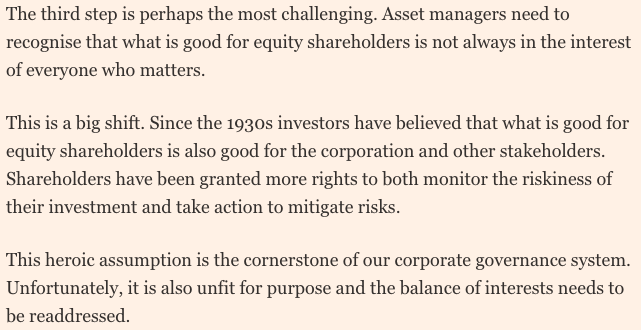
The impact of all this on public policy should be interesting. The last 20 odd years of corporate governance reform have repeatedly sought to use greater shareholder empowerment and corporate disclosure to tackle issues relating to business conduct. But now we have major shareholders stating that building an approach around equity ownership (which does not equal ownership of the company issuing equity) has flaws. That's going to call for something different.

Tuesday, 1 January 2019

Infrastructure investment politics

A couple of stories caught my eye over the last few days, both relating to the ownership of infrastructure.

The first piece is from the FT and looks at the dividends paid to the owners of the UK's airports. This contrasts the amounts paid to shareholders and the debt issued. It also suggests friction between airport owners and airlines, with some moans about airport owners taking out dividends rather than investing in their infrastructure or reducing landing charges. I am unclear to what extent any of these moans are a) new or b) more of a general howl of pain from carriers.

However, I assume this piece has not come out of the blue. Someone has been complaining. And it's notable too that this piece is in the same sort of vein as the FT's coverage of Thames Water (though there seem to be more interesting questions about the financing arrangements in that case).

The second story is a GMB press release highlighting the largely foreign ownership of Anglian Water. I take my hat off to the GMB for getting some decent coverage out of something pretty straightforward - you can find the % of foreign ownership by looking on the Anglian Water website here. I think they are hitting on a vulnerable aspect of institutional investment in infrastructure in the UK - yes, there are pension funds in the mix, but they are largely overseas (thought 15% held in the UK is not insignificant).

As I've blogged before, I think this makes the politics a lot easier for advocates of public ownership of utilities. It's interesting that Anglian Water explicitly talks about who their owners are:
The vast majority of our shareholders are long-term public sector employee pension funds.
I don't know if this is actually true. CPPIB is not really a "public sector employee" pension fund, I think it covers everyone. Also the assets managed by IFM and Colonial First State (both of which are asset managers, not pension funds) could be public or private sector. The Abu Dhabi Investment Authority is a sovereign wealth fund I think. Dalmore is an asset manager, though does have public sector pension funds as clients. So it's only really GLIL that unequivocally matches the company's description.

The point I would take from from both stories is that there is a growing argument about the nature of ownership of infrastructure. These things have always been there (well ever since the assets were sold off), they are coming to attention now because the pressure around public ownership is building.

Saturday, 29 December 2018

Kier Group ownership changes


Following the mess that was Kier Group's rights issue last week there are some interesting regulatory filings that provide some idea of what is going on under the surface.

Here is Aberdeen Standard increasing its holding (relatively speaking) to become (after some other moves) the largest shareholder with 15.85%. And here is Woodford's holding coming down to 13.58%, presumably because it didn't take up its full allocation under the rights issue. 

More interesting is Peel Hunt - one of the underwriters that was left on the hook after the rights issue flopped. Left with unshifted stock on their hands they briefly ended up with 17% of issued shares on the 20th, only to dump them on the 21st, reportedly for 360p.

There's a nice bit by Alistair Osborne here (though the total shorts in Kier Group were - I am told - more than double the level if you add up those disclosed by the FCA).

And talking about those shorts, the FCA list now shows a total of just 4.62% - a big drop after the rights issue as you would expect. BlackRock's short position - which had been at 2.73% up till last Wednesday was reduced to 0.76% on Friday. (graph below nicked from Shorttracker - only FCA data in this tho).


I imagine that the combination of underwriters dumping of a large block of stock on the cheap and the need to close out short positions means that some of these folks made out pretty well last week.