To be honest, I'm not looking forward to election day tomorrow. If the polling is right we can expect a Conservative majority and Brexit to go ahead, neither of which are my favoured outcomes! I thought the same would happen in 2017 and it didn't, so who knows.
Also in 2017 I blogged about how in my corner of the world a broadly 'Left' take on corporate governance was winning, even as it looked life the Left was losing in the Big P political field. This trend has only continued in the following 2 years. Positions that were once only advocated by the likes of the TUC, High Pay Centre etc have become fairly standard.
Another thing I've blogged before is that the political value of business endorsements in election campaigns has declined significantly. It might even be a net negative now. And this is a point on which Boris Johnson, a politician who seems to have no guiding purpose except getting into power, is obviously alert to.
In this respect it's interesting to note that in this election one of the previous staples of Conservative campaigns is missing (no, not Jacob Rees Mogg...): the collective statement from business leaders warning against a Labour government. This was literally a front page attack in the 2015 campaign. So where is it this time? I can't believe that the Conservatives couldn't organise a similar joint letter now, when Labour is positioned further to the Left and advocating taking some businesses into public ownership. Perhaps some feel it is too dangerous to speak out, but there must be a reliable core of party funders and friends that could be put together.
So my gut feeling is that the Conservative campaign team may think that such an endorsement (or, seen the other way, corporate attack on a particular outcome) would be a net negative. Certainly you can imagine Labour immediately trying to flip it into evidence that corporate interests dominate Right politics. If my hunch is right, then it's just a bit more of an indication of how politics has changed from the 1990s, and from the crash in particular. It has some interesting implications for those of us in ESG land, which I'll return to at some point.
PS - VOTE LABOUR.
Wednesday, 11 December 2019

Sunday, 8 December 2019
Shorting and voting
As some people will be aware, I've been looking into changes in voting turnout at companies in trouble. Short version: turnout has fallen at several such companies, in some cases significantly. Why this might be is another question. Since several of these companies were also been heavily shorted there's a potential explanation. Perhaps investors lending shares to those shorting were not recalling them in order to vote.
So I've had a look at public shorting data (which I know is limited) and plotted this against turnout. The charts below are v basic. I've just looked at the short position on (or shortly prior to) the date of the relevant meeting. Really I ought to put more shorting data in, as obvs the shares don't get lent out and shorted immediately before meetings.
Anyway, it looks like there is a bit of a correlation, although the Debenhams example does not show that at all. So it's possible that something else is going. Perhaps changes in the register explain it - as companies get into trouble big institutions who are more likely to vote are no longer there in numbers. Or perhaps some investors just give up - if you're an indexer who has to hold the shares, but know the company is doomed why vote? Why not at least get a bit of lending income? So not a straightforward story.
PS - Premier Oil obvs not in the same category as the others. I included it as the story about the massive short in the company is in the press today.


So I've had a look at public shorting data (which I know is limited) and plotted this against turnout. The charts below are v basic. I've just looked at the short position on (or shortly prior to) the date of the relevant meeting. Really I ought to put more shorting data in, as obvs the shares don't get lent out and shorted immediately before meetings.
Anyway, it looks like there is a bit of a correlation, although the Debenhams example does not show that at all. So it's possible that something else is going. Perhaps changes in the register explain it - as companies get into trouble big institutions who are more likely to vote are no longer there in numbers. Or perhaps some investors just give up - if you're an indexer who has to hold the shares, but know the company is doomed why vote? Why not at least get a bit of lending income? So not a straightforward story.
PS - Premier Oil obvs not in the same category as the others. I included it as the story about the massive short in the company is in the press today.


Monday, 4 November 2019
Labour and Capital
It's election time. I'll have a look through party manifestos when they're out to pull together policy commitments that are relevant to this blog. In the meantime, here are a few rehashed thoughts about what I'd like to see as a Left platform.
1. Employee representation at board level.
The Conservatives' botched reform in this area has left the door open to further reform. As the failure of most companies to appoint employee directors shows, this is not going to be achieved through 'comply or explain', especially when some asset managers will likely lobby against. So legislate for it. Minimum of two on each board.
2. Redefine directors' duties.
This is straightforward, but important. As I saw someone comment recently, Section 172 as it stands actually made shareholder primacy explicit, even as it was pitched as 'enlightened shareholder value'. Check out the previous version (which put employees on a par with shareholders) to see how it changed. I am comfortable with the idea that the duty it simply to promote the success of the company, taking account of all stakeholder interests. If you don't think the current version is a problem, have a read of some justifications for exec pay and tax avoidance that prey Section 172 in aid.
3. Pre-distribution.
Pretty obvious that the big battle over the future of the firm is about different claims on resources. Pre-distribution got a bad press when Ed Miliband floated the term back in 2010-2015 parliament, but the idea is a sound one. Ensuring that labour gets a fairer share up front, rather than relying heavily on transfers, is likely to be much more politically durable. This suggests enhanced bargaining power (so let's make it easier for workers to form unions, and easier for unions to gain recognition and bargain).
But we also need to look at other mechanisms for ensuring a greater share of wealth goes to working people at the point it is created. Labour's Inclusive Ownership Funds provide one interesting model, and would create a who new class of investors which could have some interesting corpgov outcomes (for example in takeover situations). I see a lot of people speak positively about greater employee ownership in theory, so this idea ought to be popular. Those who criticise it should come up with alternatives. And if an IOF style scheme isn't applicable there should be mandatory profit-sharing.
4. Radical executive pay simplification.
Everyone in corpgov these days says they support pay simplification, but in practice most companies still have several incentive schemes. Nor am I convinced that deferred share awards get us anywhere because I don't think they will have much of a motivational effect (and I'm impressed by Sandy Pepper's work in this area). I'd scrap as much variable pay as possible. If we can't get rid of it all restrict the variable bit to small short-term cash bonuses with clawback and malus provisions. Much easier for all to understand, and hopefully easier to reclaim if something goes wrong.
5. Rebuild democratic control of capital.
Several trends in UK pension provision have served to less or remove democratic control of pension assets. The 'professionalisation' of governance is a good thing in general, but if it serves to cause the link with beneficiary interests to be broken we have a problem. In the ESG world I worry that this has led to priorities being adopted that are more aligned with the interests of those running money than those of whose money it is. So I would like to see reinvigorated member/beneficiary involvement in all types of pension provision.
6. Democratise shareholder voting
I can't see any good reason why asset managers can't find a fintech solution that allows asset owners, or retail investors, to vote in pooled funds. The current situation is ridiculous, especially in a world where more and more money is managed passively. If I'm only employing you to hold the index, not pick stocks, why should I be forced to adopt your views views on corporate governance? It makes no sense.
7. Radical disintermediation.
One for a decade ahead. Will we actually need asset managers in the future as they exist in their current form? Could passive management be a utility? Could we do it ourselves?
1. Employee representation at board level.
The Conservatives' botched reform in this area has left the door open to further reform. As the failure of most companies to appoint employee directors shows, this is not going to be achieved through 'comply or explain', especially when some asset managers will likely lobby against. So legislate for it. Minimum of two on each board.
2. Redefine directors' duties.
This is straightforward, but important. As I saw someone comment recently, Section 172 as it stands actually made shareholder primacy explicit, even as it was pitched as 'enlightened shareholder value'. Check out the previous version (which put employees on a par with shareholders) to see how it changed. I am comfortable with the idea that the duty it simply to promote the success of the company, taking account of all stakeholder interests. If you don't think the current version is a problem, have a read of some justifications for exec pay and tax avoidance that prey Section 172 in aid.
3. Pre-distribution.
Pretty obvious that the big battle over the future of the firm is about different claims on resources. Pre-distribution got a bad press when Ed Miliband floated the term back in 2010-2015 parliament, but the idea is a sound one. Ensuring that labour gets a fairer share up front, rather than relying heavily on transfers, is likely to be much more politically durable. This suggests enhanced bargaining power (so let's make it easier for workers to form unions, and easier for unions to gain recognition and bargain).
But we also need to look at other mechanisms for ensuring a greater share of wealth goes to working people at the point it is created. Labour's Inclusive Ownership Funds provide one interesting model, and would create a who new class of investors which could have some interesting corpgov outcomes (for example in takeover situations). I see a lot of people speak positively about greater employee ownership in theory, so this idea ought to be popular. Those who criticise it should come up with alternatives. And if an IOF style scheme isn't applicable there should be mandatory profit-sharing.
4. Radical executive pay simplification.
Everyone in corpgov these days says they support pay simplification, but in practice most companies still have several incentive schemes. Nor am I convinced that deferred share awards get us anywhere because I don't think they will have much of a motivational effect (and I'm impressed by Sandy Pepper's work in this area). I'd scrap as much variable pay as possible. If we can't get rid of it all restrict the variable bit to small short-term cash bonuses with clawback and malus provisions. Much easier for all to understand, and hopefully easier to reclaim if something goes wrong.
5. Rebuild democratic control of capital.
Several trends in UK pension provision have served to less or remove democratic control of pension assets. The 'professionalisation' of governance is a good thing in general, but if it serves to cause the link with beneficiary interests to be broken we have a problem. In the ESG world I worry that this has led to priorities being adopted that are more aligned with the interests of those running money than those of whose money it is. So I would like to see reinvigorated member/beneficiary involvement in all types of pension provision.
6. Democratise shareholder voting
I can't see any good reason why asset managers can't find a fintech solution that allows asset owners, or retail investors, to vote in pooled funds. The current situation is ridiculous, especially in a world where more and more money is managed passively. If I'm only employing you to hold the index, not pick stocks, why should I be forced to adopt your views views on corporate governance? It makes no sense.
7. Radical disintermediation.
One for a decade ahead. Will we actually need asset managers in the future as they exist in their current form? Could passive management be a utility? Could we do it ourselves?
Sunday, 13 October 2019
Alignment in exec pay
There's a lot of commentary from a lot of sources these days arguing against a shareholder-centric corporate governance model. So far, the commentary is far ahead of any policy, and certainly in the US there is scepticism about the motives of those - like the Business Roundtable - who have almost overnight become advocates of a more stakeholder-orieted model.
One thing that, as far as I am aware, hasn't been discussed in detail is what all this means for executive pay. I raise this because the dominant ideas relating to executive pay in markets like the US and UK are derived from agency theory, and the version of agency theory that is applied envisages the boards of companies as agents of shareholders. Leading on from this, pay is structured in a way that aligns directors' interests with those of shareholders. Hence there is a lot of emphasis on both variable pay and equity.
But if we are looking at a future in which other stakeholders are also part of the governance of companies, and in which directors' duties are no longer conceived as being solely owed to shareholders (and thus directors are not agents of shareholders) this seems open to challenge.
If pay was aligned with the interests of the workforce, for example, it would surely have a much lower variable element and more emphasis on fixed, though perhaps also expanded short-term profit-based awards (provided these are shared across the workforce).
In addition, questions about how executive pay is decided and approved might also be contestable once more. After all, if directors are not solely accountable to shareholders the fact that only shareholders vote on who they are remunerated might seem a little outdated.
So I could imagine quite a shift in various aspects of pay - provided that the nature of corporate governance itself changes.
One thing that, as far as I am aware, hasn't been discussed in detail is what all this means for executive pay. I raise this because the dominant ideas relating to executive pay in markets like the US and UK are derived from agency theory, and the version of agency theory that is applied envisages the boards of companies as agents of shareholders. Leading on from this, pay is structured in a way that aligns directors' interests with those of shareholders. Hence there is a lot of emphasis on both variable pay and equity.
But if we are looking at a future in which other stakeholders are also part of the governance of companies, and in which directors' duties are no longer conceived as being solely owed to shareholders (and thus directors are not agents of shareholders) this seems open to challenge.
If pay was aligned with the interests of the workforce, for example, it would surely have a much lower variable element and more emphasis on fixed, though perhaps also expanded short-term profit-based awards (provided these are shared across the workforce).
In addition, questions about how executive pay is decided and approved might also be contestable once more. After all, if directors are not solely accountable to shareholders the fact that only shareholders vote on who they are remunerated might seem a little outdated.
So I could imagine quite a shift in various aspects of pay - provided that the nature of corporate governance itself changes.
Sunday, 6 October 2019
Problems with performance pay
It's been a few years since I read in depth about reward and motivation. I basically got to the point where I think most performance-related pay is junk, as are most of the 'reforms' advocated, because there is little attempt to engage with the psychology obviously sitting behind all these idea.
Over the summer I read a couple of books (this one and this one) by Sandy Pepper and it's reignited my interest. He comes at these issues from a similar perspective and his books are a treasure trove of further reading ideas. He's very much of the view that mainstream agency theory, and the executive designs that flow from it, are flawed and that to correct them we need to take account of human psychology. His work is also useful in that he undertook a large-scale survey of executives to gain a better understanding of how they think about incentives. His research confirmed that executives sharply discount deferred rewards. Another couple of fascinating nuggets from the research are that younger executives are less risk averse but higher time-discounters and that financial services executives were both *more* risk averse than those working in other industries and high time-discounters.
Notably Pepper comes down in favour of short-term, simple cash-based incentives. This is a long way from the conventional wisdom - even in the ESG world - that we should be pitching at long-term equity-based incentives with lots of targets (including ESG KPIs).
Anyway, I won't try and summarise his arguments here, so below are just a handful of snippets from The Economic Psychology of Incentives that I particularly liked.
"[I]nvestors are driven by relative measures. They are selecting stocks based on relative performance by category and are worried about beating the average in the shape of an index. However, an HR director pointed out that the starting positions of managers and investors are not the same: 'Most shareholders hold a portfolio and are therefore insulated against the capricious nature of shareholder returns. We as executives are not.'"
(this is a point I was sort of getting at in my third bullet in this blog)
"The effect of non-paying LTIPs is not merely neutral - it can be positively demotivating to hold an incentive instrument which you believe will never pay out. An HR director with particular experience of this problem described it this way: 'If you get reward wrong it is a much bigger de-motivator than it can ever be a motivator. It's like walking around a china shop with a sledgehammer in your hands.'"
"[B]oards of directors, acting on behalf of shareholders, increase the size of long-term incentive awards to compensate them for the perceived loss of value when compared with less risky, more certain and more immediate forms of reward. In other words, I argue that part of the explanation for the inflation in executive compensation is a consequence of the form in which compensation is provided."
"[I]s it possible to to alert certain features of long-term incentives in order to increase their perceived value? For example, complex performance criteria appear to increase the level of risk and uncertainty in long-term incentives and hence reduce their perceived value. Executives might be more effectively motivated by receiving smaller rewards which do not have complex performance conditions attached. Most radically, might it prove to be both more effective and efficient ti arrest the trend of placing increasing reliance on high-powered long-term incentives."
Over the summer I read a couple of books (this one and this one) by Sandy Pepper and it's reignited my interest. He comes at these issues from a similar perspective and his books are a treasure trove of further reading ideas. He's very much of the view that mainstream agency theory, and the executive designs that flow from it, are flawed and that to correct them we need to take account of human psychology. His work is also useful in that he undertook a large-scale survey of executives to gain a better understanding of how they think about incentives. His research confirmed that executives sharply discount deferred rewards. Another couple of fascinating nuggets from the research are that younger executives are less risk averse but higher time-discounters and that financial services executives were both *more* risk averse than those working in other industries and high time-discounters.
Notably Pepper comes down in favour of short-term, simple cash-based incentives. This is a long way from the conventional wisdom - even in the ESG world - that we should be pitching at long-term equity-based incentives with lots of targets (including ESG KPIs).
Anyway, I won't try and summarise his arguments here, so below are just a handful of snippets from The Economic Psychology of Incentives that I particularly liked.
"[I]nvestors are driven by relative measures. They are selecting stocks based on relative performance by category and are worried about beating the average in the shape of an index. However, an HR director pointed out that the starting positions of managers and investors are not the same: 'Most shareholders hold a portfolio and are therefore insulated against the capricious nature of shareholder returns. We as executives are not.'"
(this is a point I was sort of getting at in my third bullet in this blog)
"The effect of non-paying LTIPs is not merely neutral - it can be positively demotivating to hold an incentive instrument which you believe will never pay out. An HR director with particular experience of this problem described it this way: 'If you get reward wrong it is a much bigger de-motivator than it can ever be a motivator. It's like walking around a china shop with a sledgehammer in your hands.'"
"[B]oards of directors, acting on behalf of shareholders, increase the size of long-term incentive awards to compensate them for the perceived loss of value when compared with less risky, more certain and more immediate forms of reward. In other words, I argue that part of the explanation for the inflation in executive compensation is a consequence of the form in which compensation is provided."
"[I]s it possible to to alert certain features of long-term incentives in order to increase their perceived value? For example, complex performance criteria appear to increase the level of risk and uncertainty in long-term incentives and hence reduce their perceived value. Executives might be more effectively motivated by receiving smaller rewards which do not have complex performance conditions attached. Most radically, might it prove to be both more effective and efficient ti arrest the trend of placing increasing reliance on high-powered long-term incentives."
Saturday, 5 October 2019
Are unions coming back into favour?
Perhaps I'm grasping at straws, but I can't shake the feeling that attitudes toward trade unions are shifting amongst some key groups, and that this might point to a more hopeful future.
In politics the direction of travel is most clear. Obviously Labour has adopted more union-friendly policy positions that it has held for the past 20+ years, union leaders have more influence on Labour, and Labour MPs are now far more openly pro-union. But it's happening in the US too. Both Bernie Sanders and Elizabeth Warren talk a lot more about unions - and how to make them stronger - than Obama ever managed.
But there's also increasingly discussion of bargaining power (or the lack of it) and how this affects inequality / distribution of wealth to capital v labour etc in other areas too. Leo Strine's piece in the FT last week was particularly striking. In the detail of the critique of the failure of investors to look at what happens to workers, and some 'governance-y' reform ideas (like setting up board committees on fair treatment of employees) he calls for labour law reform to give unions a "fairer opportunity to represent and bargain for their workers".
More generally, an increasingly widely-held view is that the growth in economic inequality is at least partly about falling levels of union membership and collective bargaining (it's not just about technology, global shifts etc). And the flip side of this is that more policy wonks are attracted to the idea of more flexible ways of affecting distribution of rewards than trying to determine this all via legal / regulatory interventions (which can always be reversed). Unions look like a pretty good fit there too.
To be clear, this is all mood music, and mood music never won anything for anyone. If Labour and the Democrats don't win, nothing changes, at least for now. Trump won't lift a finger to make it easier for workers to unionise. And the sort of people that Boris Johnson surrounds himself with are more likely to think unions still have *too much* power, not too little.
And we also need to be open-eyed about the challenges to unions. They need to recruit a lot of younger workers just to stand still. Yet experience of, support for, knowledge of unions is not part of the cultural fabric, or passed down through families, in the way it would have been a few decades back. This is a deep problem to address.
However, overall it does feel like there should be grounds for some optimism. A bit of luck with politics, perhaps a big dispute or two that demonstrates that inequity working people still face on the job, and some principled leadership could start to reorient politics and policy around unions.
In politics the direction of travel is most clear. Obviously Labour has adopted more union-friendly policy positions that it has held for the past 20+ years, union leaders have more influence on Labour, and Labour MPs are now far more openly pro-union. But it's happening in the US too. Both Bernie Sanders and Elizabeth Warren talk a lot more about unions - and how to make them stronger - than Obama ever managed.
But there's also increasingly discussion of bargaining power (or the lack of it) and how this affects inequality / distribution of wealth to capital v labour etc in other areas too. Leo Strine's piece in the FT last week was particularly striking. In the detail of the critique of the failure of investors to look at what happens to workers, and some 'governance-y' reform ideas (like setting up board committees on fair treatment of employees) he calls for labour law reform to give unions a "fairer opportunity to represent and bargain for their workers".
More generally, an increasingly widely-held view is that the growth in economic inequality is at least partly about falling levels of union membership and collective bargaining (it's not just about technology, global shifts etc). And the flip side of this is that more policy wonks are attracted to the idea of more flexible ways of affecting distribution of rewards than trying to determine this all via legal / regulatory interventions (which can always be reversed). Unions look like a pretty good fit there too.
To be clear, this is all mood music, and mood music never won anything for anyone. If Labour and the Democrats don't win, nothing changes, at least for now. Trump won't lift a finger to make it easier for workers to unionise. And the sort of people that Boris Johnson surrounds himself with are more likely to think unions still have *too much* power, not too little.
And we also need to be open-eyed about the challenges to unions. They need to recruit a lot of younger workers just to stand still. Yet experience of, support for, knowledge of unions is not part of the cultural fabric, or passed down through families, in the way it would have been a few decades back. This is a deep problem to address.
However, overall it does feel like there should be grounds for some optimism. A bit of luck with politics, perhaps a big dispute or two that demonstrates that inequity working people still face on the job, and some principled leadership could start to reorient politics and policy around unions.
Sunday, 29 September 2019
Patisserie Valerie and BlackRock
Just a bit of Excel fun on a Sunday lunchtime. In its relatively short life as a public company, Patisserie Holdings didn't issue that many market announcements, so it's easy to pull together TR1 notices. I know that BlackRock had a big long position that it cut right back last April. The TR1 notices it triggered show that the holding was attributed to BlackRock Investment Management (UK).
In addition the only notifiable (0.5%+) short in Patisserie Holdings history on the public market was also tagged to BlackRock Investment Management (UK). It appeared in late 2017 and dipped back down below the disclosure threshold in mid May 2018.
So I just stuck the two together in the chart below. NB - I've only recorded what I know, obviously there could have been more shorting below 0.5%. And the last position on the long side is 4.9%, as all I know is that they went under 5% (it could have gone to zero).
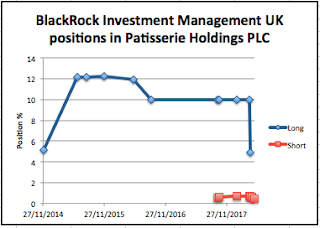
The position disclosed in the TR1s doesn't actually match the disclosure in Patisserie Holdings' 2017 Annual Report & Accounts:

It's possible that the annual report listed the position net of lending, and that BlackRock had lent out a couple of percent or so. But I'm just guessing.
Just another small thing I noticed. BlackRock discloses that it voted at the company's EGM in November last year, as it appears in the iShares voting record, with 3 ETFs holding it at least. One of these disclosures is below. However nothing turns up for Patisserie Holdings via its US mutual fund disclosures.

Because BlackRock doesn't leave historical votes online in a searchable format (sigh.....) I had to look on the SEC site to try to find out how it voted at the January AGM. But there is no disclosure for that meeting (which fell into the prior year's reporting period for the NPX form), so I'm guessing that the same ETFs did not hold the stock at that point.
So I'm a bit stumped as to how I can find how it voted at the January 2018 AGM. I assume that it voted for everything since, even it only voted the 7.2% disclosed in the annual report a vote against or abstention of 7m+ shares would have shown up in the results (as total issued shares stood at a helpfully round 100m). And there's nothing like that in the results.
Final point on those AGM results. The turnout was a paltry 29%, or 29m shares, at the 2018 AGM, down from 66.2% (66m shares) at the 2017 AGM. Luke Johnson's holding was 38.6% according to the annual report, or 38m shares. So at the least he didn't vote all his holding in 2018. And 29 + 38 gets you to 67%.
In addition the only notifiable (0.5%+) short in Patisserie Holdings history on the public market was also tagged to BlackRock Investment Management (UK). It appeared in late 2017 and dipped back down below the disclosure threshold in mid May 2018.
So I just stuck the two together in the chart below. NB - I've only recorded what I know, obviously there could have been more shorting below 0.5%. And the last position on the long side is 4.9%, as all I know is that they went under 5% (it could have gone to zero).

The position disclosed in the TR1s doesn't actually match the disclosure in Patisserie Holdings' 2017 Annual Report & Accounts:
It's possible that the annual report listed the position net of lending, and that BlackRock had lent out a couple of percent or so. But I'm just guessing.
Just another small thing I noticed. BlackRock discloses that it voted at the company's EGM in November last year, as it appears in the iShares voting record, with 3 ETFs holding it at least. One of these disclosures is below. However nothing turns up for Patisserie Holdings via its US mutual fund disclosures.

Because BlackRock doesn't leave historical votes online in a searchable format (sigh.....) I had to look on the SEC site to try to find out how it voted at the January AGM. But there is no disclosure for that meeting (which fell into the prior year's reporting period for the NPX form), so I'm guessing that the same ETFs did not hold the stock at that point.
So I'm a bit stumped as to how I can find how it voted at the January 2018 AGM. I assume that it voted for everything since, even it only voted the 7.2% disclosed in the annual report a vote against or abstention of 7m+ shares would have shown up in the results (as total issued shares stood at a helpfully round 100m). And there's nothing like that in the results.
Final point on those AGM results. The turnout was a paltry 29%, or 29m shares, at the 2018 AGM, down from 66.2% (66m shares) at the 2017 AGM. Luke Johnson's holding was 38.6% according to the annual report, or 38m shares. So at the least he didn't vote all his holding in 2018. And 29 + 38 gets you to 67%.
Subscribe to:
Posts (Atom)