Showing posts with label loyalty. Show all posts

Sunday, 6 December 2020

The costs of loyalty

I've blogged a couple of times previously about the peculiar messaging around consumer 'loyalty'. The repeated used of the phrase 'loyalty penalty', and the message that 'loyalty doesn't pay' from both consumer groups and regulators feels very odd to me. 

As I've said before I think loyalty - which I take to mean a long-term co-operative relationship - is a deeply-rooted human trait. Therefore attacking it is unlikely to lead to humans to conclude that being loyal is a failing on their part, but rather will simply engender mistrust. 

On this topic, I was really interested to see this paper last week, which is part of the CMA's response to a 'super complaint' from Citizens Advice. I've properly read about half of it and skimmed the rest (just being honest!) and it's well worth a read. The 'loyalty penalty' in a nutshell is the cost to the consumer of sticking with the same provider (for energy, insurance etc) rather than switching. This is essentially a price differential between new and existing customers, with the latter getting stung with higher costs (so their loyalty is penalised). As the paper sets out, this cost might be through 'price jumps', when low initial rates reset, 'price walking', where the provider increases costs in steps over time, or because of legacy contract, like when you're stuck on an old tariff. 

Anyway, it's a big enough problem that it has its own name, and this paper looks at academic literature on how and why this comes about and what remedies might be applied. There are loads of interesting aspects to it. For example, early on it is made clear that the approach does not consider 'fairness' - whether it's acceptable in principle to charge different customers different amounts for the same product. 

On the other hand, regulators are concerned about whether vulnerable customers (the elderly, low income households, the less educated etc) are particularly at risk. And they are. Here's a key section (had to screenshot due to weird formatting):    


And a useful table on switching (or the lack of it) in respect of energy provider. 

I feel like there is an ESG point in here. In a number of markets there are providers that are publicly listed. Are returns to shareholders being juiced by taking advantage of vulnerable customers? That might seem a bit of a stretch, but look what happened to the share price of Dignity when the CMA backed off price controls in the funeral service market (which had been considered because of concerns that grieving families were being ripped off).  

Another thought from reading this is that providers are constantly recalibrating their offer, and responding to changed regulatory environments. In an era of big data, these changes are often happening very quickly. I imagine provider algorithms battling it out with price comparison site algorithms. (Ironically one of the price comparison sites - which are supposed to be on the punters's side and aid competition - was fined for breaching competition law in a way that the CMA was likely to lead to higher premiums.) It doesn't feel like a fair fight between the ordinary punter and the providers. 

In such an environment, sending out a message that you will get shafted if you don't shop around regularly - which is the tone of much of the 'loyalty penalty' messaging - doesn't strike me as a genius move. Consumers may simply become fatalistic about getting ripped off wherever they take their business, so switching might seem like a waste of time, rather than a smart response.  

Something that really comes across for me is how much effort regulators are putting into trying to get markets, and market participants, to behave like they are supposed to. Here's another little snippet

This idea of trying to get market participants to behave more like theoretical expectations reminds me of the genesis of the Stewardship Code. Again, if it's in investors' interests to be effective 'stewards' of assets they own, why don't they just do it? Why do they need regulators to encourage them? That's another story, but it does make me wonder how many markets are like this. Combined with the 'unfair fight' I wonder if markets that are a long way from theory can ever be expected to change. 

And just as I was thinking about this, I stumbled across this comment. Basically what's the point of consumer choice in energy markets if most punters can't/don't want to exercise it, and if regulators might make better choices for them?

The fact that this is in a report commissioned by the Competition and Markets Authority is a bit interesting to put it mildly. 

Anyway, worth a read.

Saturday, 15 February 2020

Globalisation and small c conservatism

“He… told us we had to go straight to the Celtic Manor in Newport – 50 miles away – by five o’clock to sign the documents and British Coal executives would be flying down to meet us by helicopter. Even I could not believe this. They had won but they wanted us to suffer some more. When we got there, there were 15 senior British Coal executives in all their glory waiting for us. They told us to sign the documents and remember that it was us that voted to close the pit and not them…

“We got back in the car after only about ten minutes at the Celtic Manor and for the first time I started to cry uncontrollably. I’m sure you can imagine that if you are in a car with six miners and one of them starts crying, it really is the others’ worst nightmare. These are tough men and they are good men but they cannot handle a man crying. All they could do was pat my shoulder and say, ‘Ty it will be alright’, but I could not stop. I could not believe we were losing the colliery; even though my father had been killed at Tower, I loved the pit and the people there. I had spent most of my working life there. This was a dreadful day and I hated what they had done to us.”  
Tower of Strength, Tyrone O’ Sullivan

“[A business like Facebook] cannot be easily pinned down, and the question where it is, for purposes of taxation, legal accountability and obedience to sovereign laws and policies may be decidable, but only by convention and without calling upon any basic loyalty of the firm. The arrival of Bitcoin and Blockchain may facilitate this mass escape from the grip of sovereign overlords, by making currency itself into a network of freely associating users, outside the control of any state.

“More and more businesses are built on this model, offering goods and services through networks that ignore national boundaries, coming to earth here and there like Amazon and Ikea, but only temporarily and only where the tax regime is favourable… [T]he the advantages provided by the Internet have given rise to a new kind of business, which owes obedience to no nation state…

“Economic activity has become detached from the building of communities. We do not know the people who produce our goods; we do not know under what conditions they work, what they believe in or what they hope for. We do not know the people who distribute those goods to us, except perhaps as celebrity CEOs – people who seem miraculously to escape all responsibility for their products, which are not their products anyway, but goods moving around the world under their own propulsion, on which they have managed in passing to stamp a brand. Local stores and local producers are successively bought up or driven out of business by anonymous chain. Any when a community tries to defend itself against the intruding giant it finds that all the cards are stacked against it, and that yet another anonymous agent, the abstract ‘consumer’, has already declared a preference for a shopping mall on the doorstep.” 
Where We Are: The State of Britain Now, Roger Scruton


I've been reading an odd mixture of books recently. I'm making an effort to read some people on the Right to try and understand where they are coming from a bit more, hence the Roger Scruton snippets above. But I've usually got something finance and/or ownership-related on the go too. Recently I picked up a secondhand copy of Tower of Strength (thanks for the The Mission gags on Twitter already, Duncan and Andy!) which is about the worker buyout of the Tower Colliery in the 1990s.

There's an interesting overlap in all this. I've blogged a bit before about loyalty (and I keep meaning to write more about it) and it really comes across in these books. Scruton's book is basically about how Britons might pull together post-Brexit, and it is a open attempt to try and find some common ground. As you might expect, I struggle to connect with some of it, but the section on globalisation, from which the snippets above are taken, really interests me in a couple of ways.

Firstly, if you did not know the identity of the writer I think many people might assume they came from the Left, rather than the Right. I think that many/most people on the Left would agree with the tone of it, and there's quite a bit more in a similar vein in that chapter. The notion of modern companies as footloose, almost ethereal entities which can use legal trickery to make profits move from one location to another is a familiar complaint. As is their lack of commitment to any particular region or nation. I could imagine almost exactly the same words being written by Wolfgang Streeck.

Secondly, some of the language is very interesting. I'm particularly struck by the use of the word 'obedience' in a couple of places. The implicit notion seems to be that firms ought to be accountable, at least to the nation or its its government, but no longer are. 'Obedience' is a word that I imagine leaves many people on the Left feeling a little queasy, since it suggests deference to authority. But it's a very powerful idea on the Right, and it plays into Jonathan Haidt's stuff on moral foundations.

Flipping to the Tyrone O'Sullivan book there are some commonalities and some differences. A big difference is that in the passage above 'obedience' - being made to sign the forms shutting the pit - looks very negative. O'Sullivan is a 100% militant NUM guy, his whole history is about workers' self-determination, through the union and then by buying the pit that they worked in. Obedience to those in authority is not an obvious part of his make-up.

At the same time the way he talks about the colliery is very emotional. He and his workmates have a love-hate relationship to it, in that it's where they had many bitter fights with the employer, but also experienced comradeship. It was their home for most of the week. So pretty much the worst thing you could do to them was make them put their names to agreeing to close the pit. And what about the executives - literally flying in, and using a bit of paper to end a way of life. It's almost designed to make Scruton's point. 

The sense of a lack of loyalty, commitment or accountability on the part of companies and executives towards workers or communities or localities seems to link up some otherwise quite disparate groups.    There's a similar thread running through David Skelton's book that I blogged about last month. I suspect that some Conservatives see this as fertile political territory, and this may yet affect the decisions of this government. But that's an unfairly superficial take. Small c conservatives (in various parties) genuinely feel companies are not behaving in an honourable way. 

My sense is that there is still a quite a lot of room for manoeuvre for those that want to try and make companies more accountable. I could imagine quite a radical conservative take on all this that could encompass ownership, taxation, directors' duties etc. It might look quite 'Left' but argued from the 'Right' - in terms of obedience to national law, loyalty to people and place, fairness in relation to paying taxes, and so on. It feels like a potentially powerful mix.

To finish on the same theme here's an excerpt (from a novel) that I've always liked.

“In the old days, if a factory owner sweated his workpeople, sooner or later, if things got bad enough they stoned his carriage or booed him in the street. If a farmer was a wicked employer they burnt his ricks. And if a landlord was cruel enough and oppressive enough, they could break his windows, or at any rate march up to his house and caterwaul outside his front door. They knew who the industrialist was, who the farmer was, who the landlord was. Those people had names and faces, and it was common knowledge where they lived… But this new tyranny is quite different. You don’t know where the head of the combine lives, even if you happen to know his name.” 
Brensham Village, John Moore

Thursday, 2 May 2019

The loyalty 'penalty'

A few months back I blogged some initial thoughts about the idea of loyalty. To recap, I find it jarring that various bodies increasingly try and encourage us to be disloyal. While I get that it's silly to be 'loyal' to a utility provider (or insert your own product/service provide), there's something about encouraging disloyalty that feels weird.

As I've blogged previously, if you look at moral foundations theory loyalty is one of the core pillars, though apparently it resonates a lot more with 'conservative' people (this obviously assumed you have confidence in any psychological research, which is a question for another day). So I am not at all sure that telling people that loyalty is stupid - basically what Which? and others say - is going to make them 'disloyal'. I think they will just become cynical about providers.

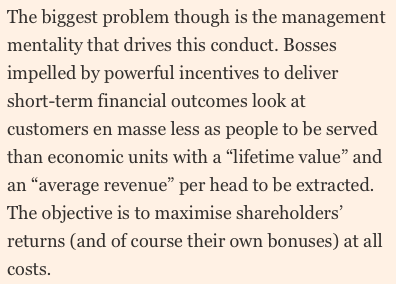
A piece by Jonathan Ford in the FT this week covers similar ground and adds a couple of points that are worth clocking. He notes that there is now even a term - the 'loyalty penalty' - for the way that providers screw over long-term customers by offering them poor deals (indeed this is language the CMA uses). He says the scale is vast - an estimated £4bn a year - and that the worst offenders are in concentrated/oligopolistic markets. Interestingly he also links it to the need to keep financial stakeholders onside, at the expense of others:


Whether you agree with that or not, it's hard to argue with the conclusion that the net result is further damage to the reputation of those businesses involved, and to belief that the market can sort it all out.

To circle back, this is why I find the "don't be loyal" messaging by the likes of Which? a bit odd. It feels like it's saying it's your own stupid fault if you trust providers, of course they are going to try and scalp you. And that the responsibility is on you to avoid getting ripped off, rather than on the provider to not to try and rip you off in the first place. And combine that with monopolies like utilities, where "shopping around" just means choosing a different logo on your bill. I have to choose between one of these firms, but I can't rely on them not to rip me off, so I should assume I will have to engage in a tactical battle of regularly switching with them to avoid it, even though the product I receive at the end is the same.

As I blogged last time, I don't believe that faced with all this people are going to think that it is their 'loyalty' that is a bad thing, I think they are going to conclude that the system is a swindle. Arguing for regular switching in terms of not being loyal is going to feed a sense of distrust. It's only going to increase support for radical intervention, be it tighter regulation or changes to the nature of ownership.

Sunday, 20 January 2019

Loyalty: a few initial thoughts

This tweet from Which? caught my eye the other day, and is something I've been thinking about a lot lately:


The tweet (which is currently pinned!) referred to the cost of sticking with the same broadband providers, and it reminded me of a similar tweet from ex Adam Smith Institute dude Sam Bowman before xmas:


And when I Googled "loyalty doesn't pay" I found other examples with the same message, like this:


In a way there's nothing new here. You'd expect advocates of market forces to argue that people (consumers) should move around rather than being "loyal" to a particular provider. They are typically very attached to "exit" as a discipline.

And obviously it's good advice on one level. There's not much point being loyal to an energy provider if you're paying more than using a competitor. If the amount involved is big enough to overcome the faff involved in switching it makes sense.

In the corner of the world that I inhabit, loyalty is not a prized value either. In fact incentives for loyalty are extremely unpopular. A significant case for me was DSM back in 2007. The company was seeking to introduce a loyalty dividend so that if you held the shares for longer you got slightly higher dividends. But it was attacked by asset managers and eventually scrapped.

At the time I was surprised, these days I am not surprised at all. A subsequent report on loyalty incentives by Mercer and Generation issued in 2013 found institutional investors opposed to loyalty rewards:
Respondents identified four main obstacles in utilising loyalty rewards as a means to overcome the root cause of the short term pressures found in the full investment chain: 1 – Discrimination between shareholders due to belief in “1 share, 1 vote” 2 – Risk of unintended consequences 3 – Administrative complexities 4 – Uncertainty that loyalty driven securities would incent a significant change in behaviour and address the root causes of short-termism
Just to be absolutely clear: investors oppose rewards for loyalty on principle even though they have the potential to gain from them. They do not want to see "exit" disincentivised (relatively). Perhaps views have changed in the 6 years since the Mercer report, but I doubt it.

I would argue that there has been a similar development in employment. Many employers have sought to shed their obligations to their workforce and they increasingly seek to deny an "employment" relationship at all. One of the most interesting books I read last year was The End Of Loyalty by Rick Wartzman (nice review here), which is all about the changing relationship between employers and employees (and their unions) from the immediate post-war period to the present day. The big theme is that as organised labour's power diminished so employers became less willing to offer long-term security to employees. Loyalty was undermined. Notably, he also sees the shift to shareholder value / shareholder primacy as part of the explanation.

Finally - and perhaps this is a bit of a reach - I personally find complaints from politically active and knowledgeable people that they are "politically homeless" a bit jarring. To me, they come across as betraying quite an entitled and transactional mindset - a political party should align with all my views and values or it cannot count on my vote. There's a great quote about politics that I read some time last year which was along the lines that loyalty that doesn't cost anything is meaningless.

I think there's a lot in all this worth exploring but here are a few initial thoughts. I think that to many actually existing humans, loyalty is an admirable quality, not something to be discouraged. Loyalty is at the core of some of the things we care most about. We actively profess loyalty to our football team, or our country, or our political party and, yes, sometimes even to brands and products. What's more, we demonstrate (and measure) loyalty by the length of our commitment and by what we endure along the way. We respect those who suffer for their support and loyalty, and denigrate those who only profess allegiance in the good times and/or go missing when it gets tough. In political/moral psychology, loyalty/betrayal is one of the pillars in the moral foundations theory associated with Jonathan Haidt.

Yet look at that Which? tweet again. Yes, there is a context but the message is very very clear: loyalty costs you, it's a self-defeating trait. I wonder what kind of reaction this creates. My gut feeling is that, rather than eliminating the concept of loyalty in this field (presumably the objective), it engenders distrust. If loyalty is a concept with which I make sense of the world (and likely it's part of my mental make-up for evolutionary reasons, so it's not something I can just "switch off"), and I discover (or am told, in this instance) that certain organisations will take advantage of my loyalty then I am not going to think highly of them. If I learn/am taught that my loyalty will be exploited by an entire sector (insurance companies, in Sam Bowman's tweet), I am likely to conclude that the whole sector will betray me and therefore cannot be trusted. I think it's less likely that I will conclude that my sense of loyalty is the problem.

When I look at the way that institutional shareholders react to loyalty rewards - which some would no doubt consider to be economically rational - I wonder what the reaction in turn of the humans working for companies like DSM is. Again, my gut feeling is that it suggests - or confirms - that you shouldn't trust asset managers. I think this is why the question of asset managers shorting their own clients jars with me. I don't believe that the human beings who are executives at the companies being shorted simply think "fair enough, that's how the systems operates, and they have Chinese walls". I think it will sting emotionally, at least some of them. I know some of them consider institutional shareholders to be entirely mercenary.

And in the world of employment, I suspect that we are still only starting to see the counter-reaction to the reduction of employer loyalty to employees. In the past a lot of employees felt some loyalty to their employer, it was part of their identity. But, if you read a book like Hired you can see that sense of loyalty is gone, along with social clubs and defined benefit pensions. If millennial workers don't trust employers (because of the lack of loyalty) we perhaps can't be surprised if they demand a lot to come onboard / stay onboard, because they expect to get shafted.

So perhaps the widespread distrust in institutions at least in part results from the violation of loyalty. And emphasising the desirability of "exit" - and the foolishness of remaining loyal - exacerbates this. (I think there is a link to the idea of self-interest as a norm, that I blogged about a few years back.)

Anyway, I think this is a theme I'll be blogging about more in future.